How can one organize the life’s work of an artist who created throughout her entire life?
The work on Ellen Banks’ estate began as an open, self-organized process. A small team—lacking traditional expertise in managing artists’ estates but possessing curiosity, respect, and diverse perspectives—set out to engage with a vast body of work that had been preserved in fragments.
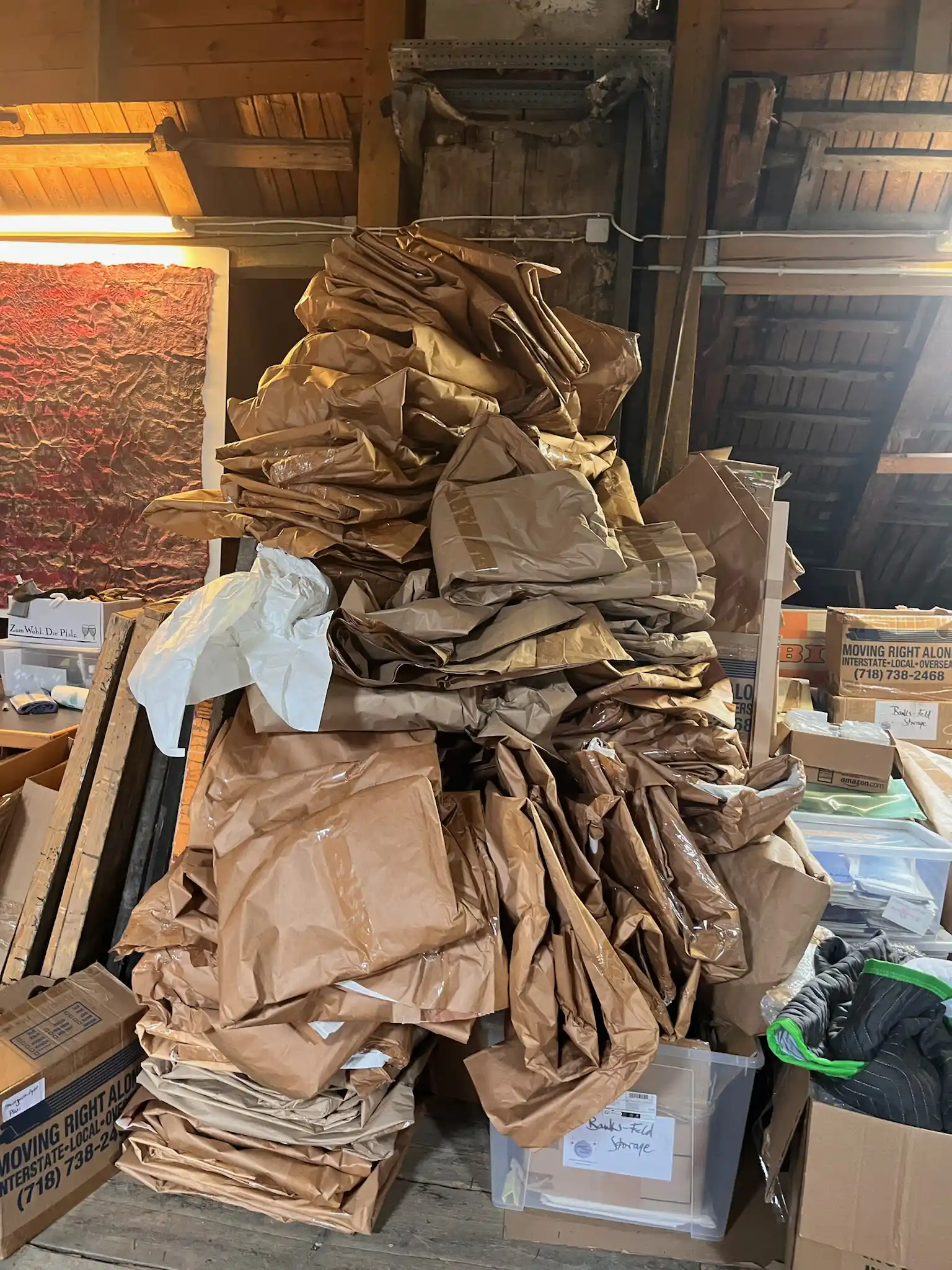
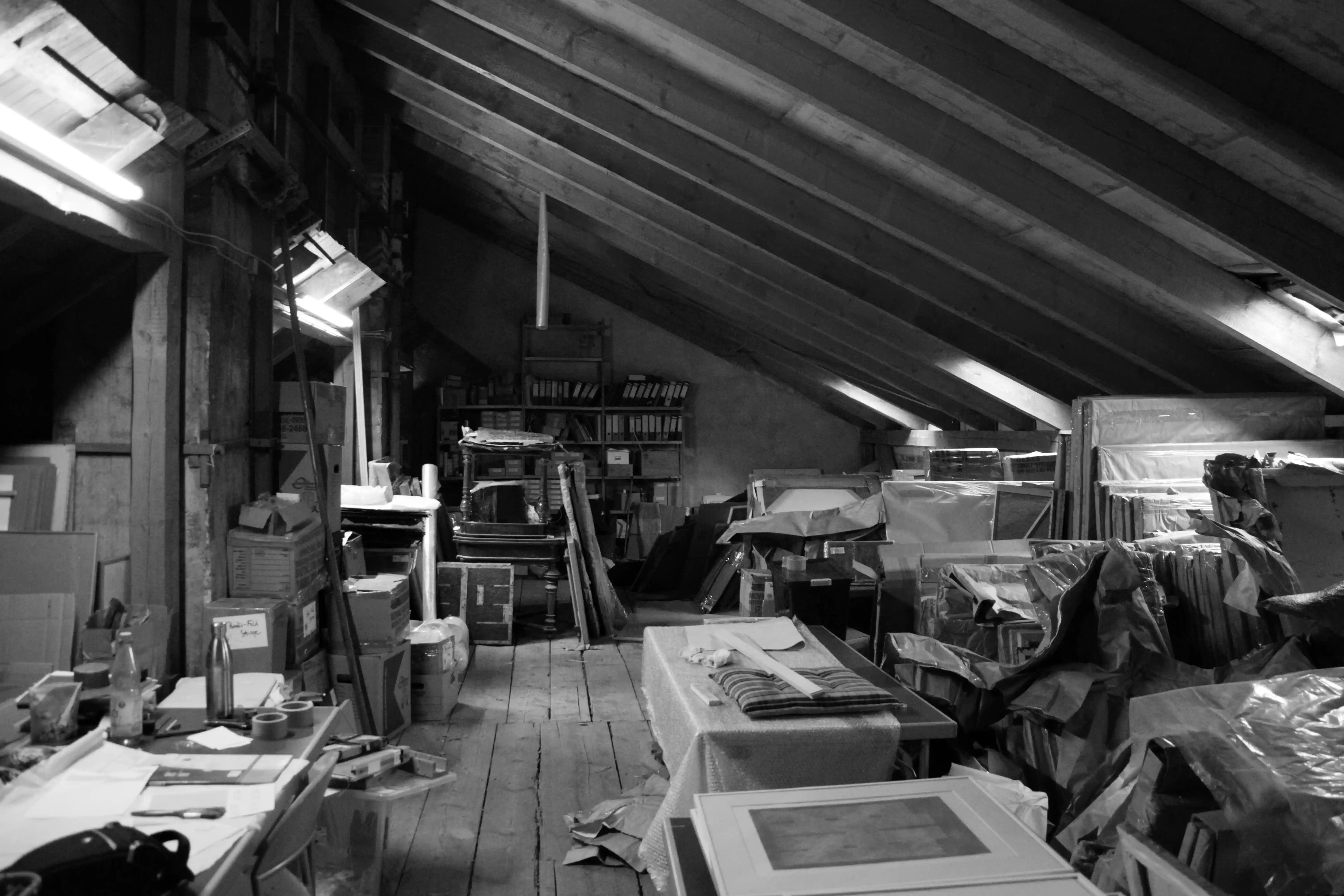
In her will, Banks stated that her artistic legacy should be transferred to Berlin—a city where she had wanted to spend her final years. This wish remained unfulfilled: she died of cancer in 2017. After prolonged legal disputes, a container arrived in Berlin in 2021—filled with works, fragments, personal items, and unanswered questions. A disordered treasure that has since been gradually unpacked.
The first step was a systematic inventory. The works were unpacked, cleaned, photographed, and cataloged—one by one. This resulted in an initial digital list:
Inventory number 23/001, Adagio, Moonshine Sonata – Measure 20, handmade paper on canvas, acrylic paint in multiple glazes, undated.
Viewing number 23/002, untitled, wax on wooden panel, encaustic, no date.
What began as a simple tabular structure quickly evolved into a tool for insight. Each column—material, technique, condition, dating—raised new questions. With each work, the categories were questioned; with each new column, the perspective on the entire estate shifted.
Today, the digital sheet is a multi-layered archive. It not only documents the support, technique, dimensions, and series affiliation, but also contains visual descriptions, notes on surfaces, color tones, text quotations, as well as traces of artistic improvisation, aging, and damage.
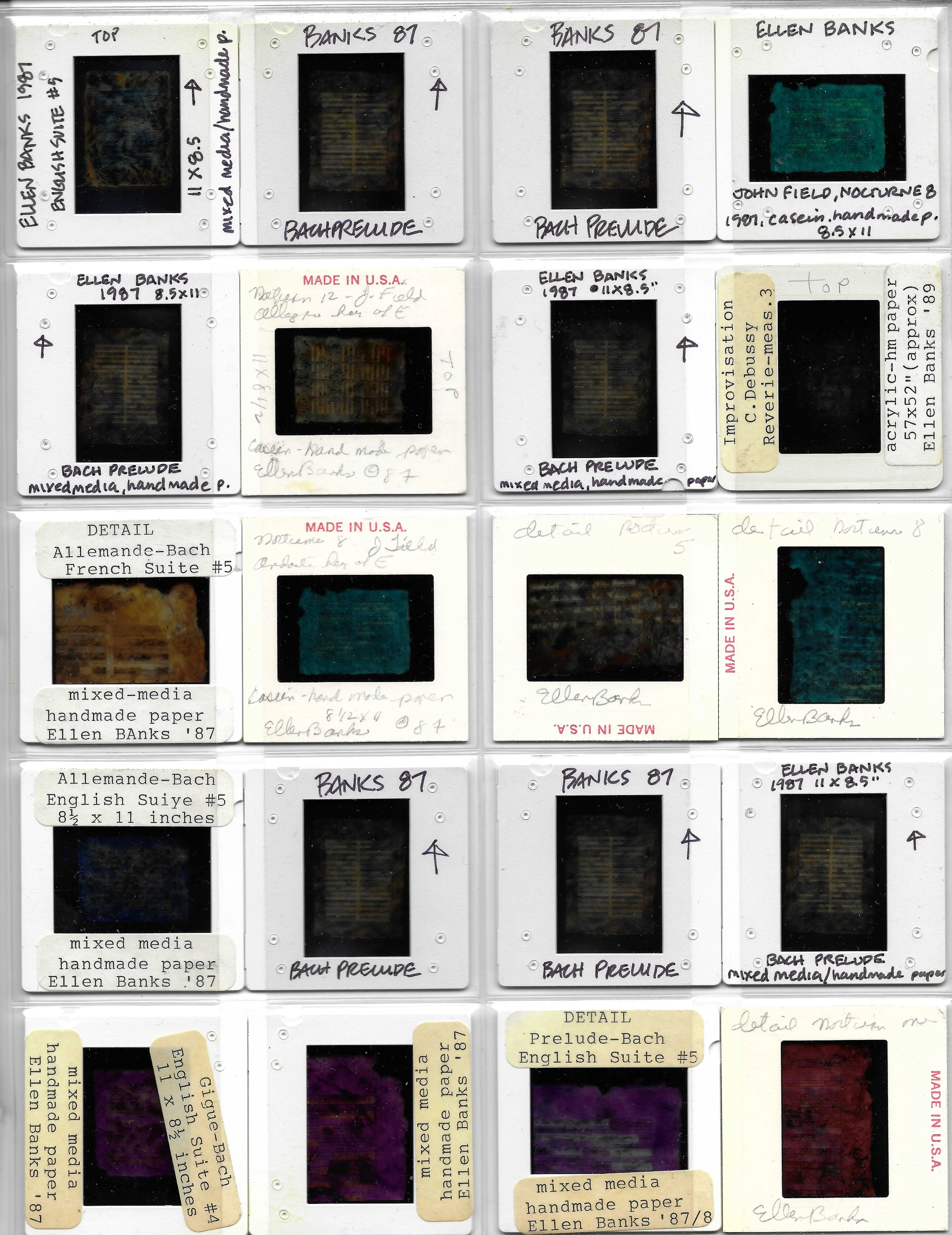
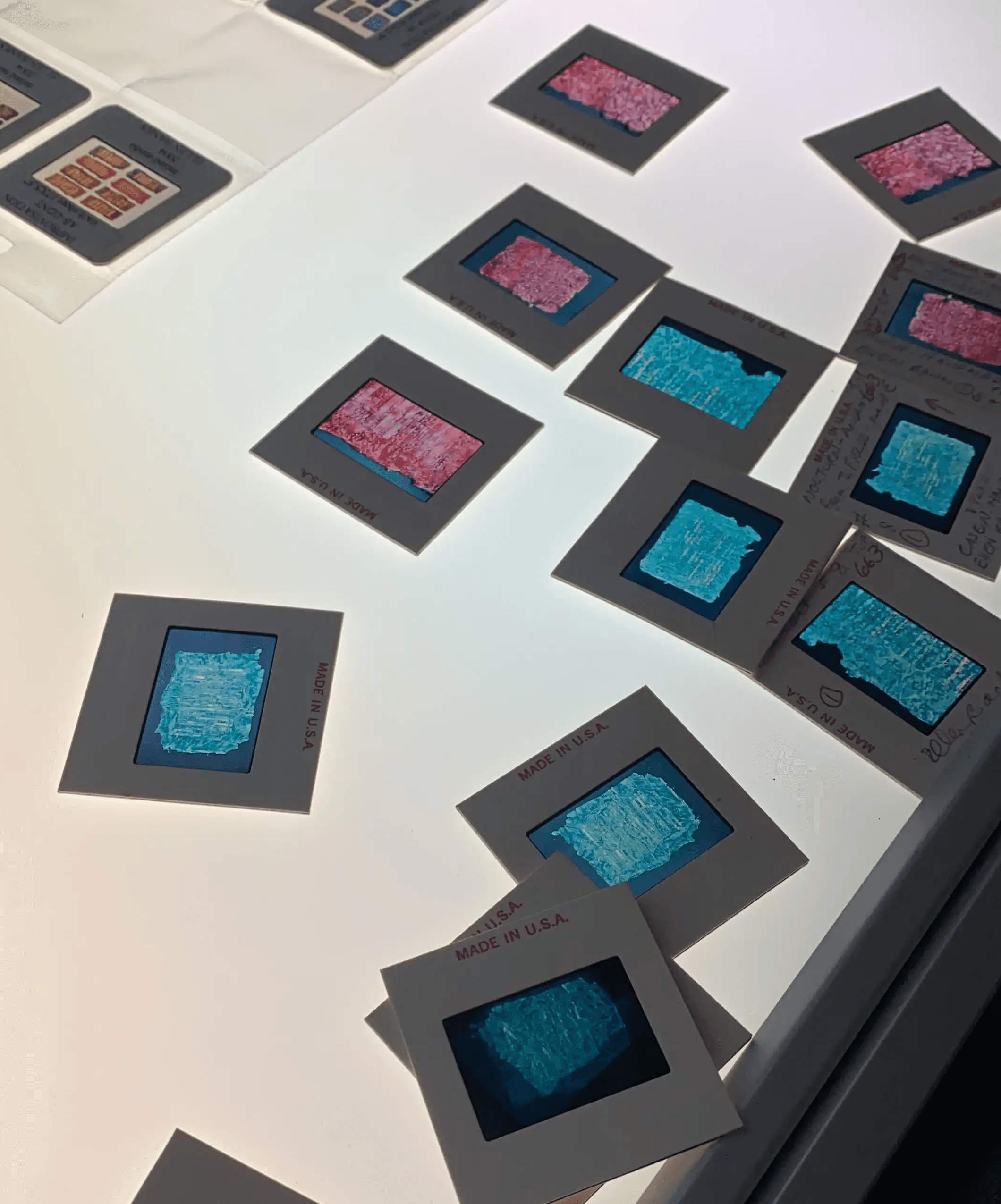
The collection comprises several hundred works: numerous encaustic pieces, works on handmade paper, acrylic paintings, sketches, notes, and accompanying materials. In addition, there are textile works, copper plates with associated prints, and an extensive collection of documentary materials—diaries, correspondence, slides, notebooks, and multimedia data carriers from various phases of life.
Much of this has not yet been fully documented, but it is gradually taking shape and opening up new perspectives on Ellen Banks’s work and personality. In this context, we might recall Loretta Würtenberger’s observation that “the archive is the negative form of artistic life in text and object.”
The work on the estate is not linear. It resembles an open system in which order emerges through observation. The inventorying process thus becomes a translation: a simple reference number evolves into a complex signature that brings together the material, context, and history of a work.
Thus, over time, 23/001 became EB/CS-C/MM/NS01_ (23/001)_T, and Mood Indigo, with the reference number 23/041, became EB/CS-W/E/TE06_(23/041)_R.
The inventory number serves as a collection of relevant information—it refers to the artist, medium, technique, title, signature, date, framing, and condition. Much of this information could only be reconstructed through notes on the backs of the works or by cross-referencing with print and archival materials. The process resembles a puzzle whose meaning unfolds only over time, revealing creative phases and working methods in the process.
The goal is not to establish a definitive order, but rather to reveal a body of work that speaks in layers: through color, structure, notation, and memory. It is being archived to remain accessible—for the present and for future engagement with the work.
Accompanying the cataloging of the work, the information is cross-referenced with catalogs of earlier exhibitions, press releases, private correspondence, and an extensive slide collection that Banks used to document and communicate her work. Additionally, contacts were established with the artist’s associates, including the photographer Louis Rouge and the curator and art historian Dr. Kenneth Hartvigsen, who collaborated with Banks in New York.
Insights into this ongoing process were shared with the public through several exhibitions, including at the Künstlerhaus Brieselang (2023), the Galerie Grolmann (2024), and the ZAK – Zentrum für Aktuelle Kunst (2025).
© 2026 / Ellen Banks Archive